Phoebe’s Cafe website -
case study

This project focused on designing the website for Phoebe’s Cafe. This was a UX/UI Course assignment, which required me to design a site for an imaginary local business—a new coffee store that was yet to open in an urban creative area.
The assignment had a length of 4 weeks. My primary role involved UX and UI design, utilizing Figma as the main tool. This project provided me with the opportunity to learn about the basics of UX and UI design and apply that knowledge to the final project in Figma, resulting in my very first attempt at designing a website from scratch.
Type of project
UX/UI Course assignment
Length
4 weeks
Role
UX and UI design
Tools
Figma
-
Phoebe, the owner of a coffee store yet to open, needed to attract new customers before the store’s launch date. The cafe was planned for an urban creative area popular with professionals, students, and young families.
The core challenge, defined in the problem statement, was that Phoebe was struggling to know what content to put on her website and whether she should consider other methods to help her create noise before the grand opening.
-
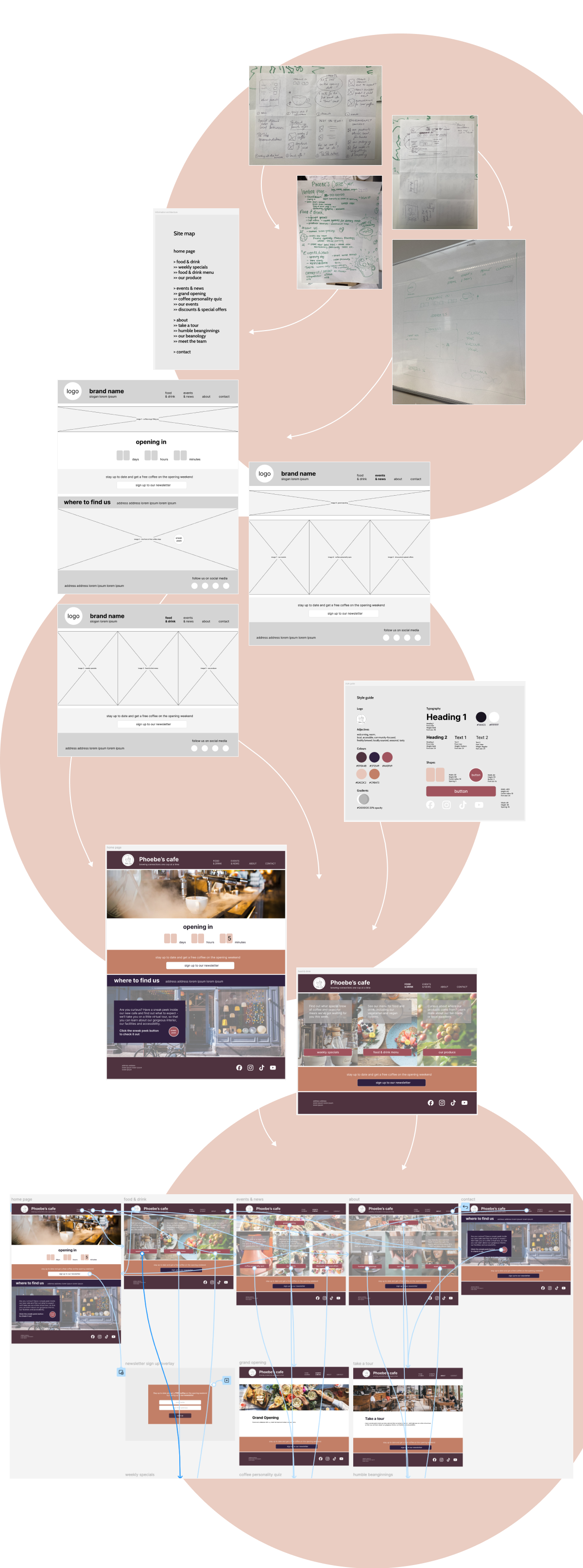
The comprehensive solution involved the design and production of a functional website, leading to the creation of all high-fidelity user interfaces and a working prototype. Additionally, a dedicated style guide was created for the website, building upon expanded knowledge of style guides.
The specific features integrated into the website design aimed directly at establishing a community presence, building trust, and driving anticipation necessary for a new business launch:
• building anticipation: the landing page prominently features a countdown to the opening date, immediately followed by the cafe’s address. This setup generates excitement and provides crucial logistical information to the audience, helping to "create noise" before the launch
• anticipating user needs and accessibility: the site provides essential, practical information such as menus. Furthermore, it includes a virtual tour of the cafe. These features help manage customer expectations and address diverse accessibility needs, such as ensuring information regarding allergies, catering to neurodivergence (e.g., providing predictability), and detailing physical accessibility features
• building community: the website fosters early community engagement by featuring information about upcoming events and providing a clear mechanism for users to sign up for a newsletter
• building credibility and trust: to establish credibility, the website focuses on the company’s ethos. This includes discussing the sourcing of fair trade products, introducing the team, and highlighting their expertise, knowledge, and passion for coffee
• enhancing engagement through gamification: a coffee personality quiz was introduced to enhance user engagement and build a deeper emotional connection with the brand.
All these specific sections and features were designed to directly respond to the needs of a new business aiming to establish their presence in the community and attract new customers.
-
My approach to this project began with collaborative teamwork before moving into independent design execution.
• Teamwork and Ideation: As a group, we were presented with the brief. I thoroughly enjoyed our group exercises and the whole ideation process, which included diving into crazy eights and engaging in group discussion to explore different ideas and ways of approaching the assignment. Following our team’s discussions, I intuitively started working on the information architecture (IA) and drafting some first low fidelity wireframes to summarise our findings.
• Individual Work: Later on, I carried on the work independently. I started this phase by digitizing my notes on IA and developing more mid-fidelity wireframes. While doing this, I also completed some competitor analysis. As I was learning the basics of Figma, I produced all high-fidelity user interfaces and eventually created a working prototype.
• Prototyping, Testing, and Refinement: During this design process, I would actively seek feedback from my tutors, fellow students, and friends in order to test my designs. This input was crucial, and I applied the feedback to improve the visual hierarchy, the contrast, and the flow of my designs. In the meantime, I expanded my knowledge of style guides and created one myself, specifically for this website
-
I was proud to present my final work, the interactive Figma prototype, as my final project at the end of the course. The deliverables included all the high-fidelity user interfaces I produced and the working prototype. This project was the result of my very first attempt at designing a website from scratch.
Through the process, I gained valuable insights and skills:
• Design Process Learnings: I learned about the different stages of the design process. I got to experience the joy of team work during the ideation phase and how satisfying it is to then turn these ideas into design when developing them on my own.
• Design Refinement: By seeking and applying feedback from tutors, fellow students, and friends, I was able to improve the visual hierarchy, the contrast, and the flow of my designs.
• Technical Skills: While on this course, I also had an opportunity to learn the basics of HTML and CSS, which I know will be very useful when working and communicating with developers on any future projects.
• Future Growth: This project motivated me greatly. At the end of the course, I was excited enough to sign up for the UX/UI Bootcamp to be able to deepen my knowledge and develop further skills. I especially wanted to learn more about UX research, testing, and user centred design, as well as build my confidence in UI design. I feel that my progression in this regard can be seen in my next case study.